
Dart Boards
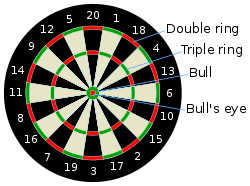
Before the first world war, pubs in the United Kingdom had dart boards made from solid blocks of wood, usually elm. They had to be soaked overnight to heal the holes made from the darts, and it was a messy business for the publican, although darts is a popular game. This changed when a company called Nodor, whose primary business was making modeling clay (which has no odor, hence the name Nodor) made a dart board. Their model of dart board wasn't a great success until someone came up with an idea to make a dart board from sisal fibres.
Small bundles of sisal fibres of all the same length were bundled together. The bundles were then compressed into a disk and bound with a metal ring. It was an instant hit as the darts made little or no damage to the board as they just parted the fibres when they entered the board; this type of dart board was more durable and required little maintenance. Modern dart boards are made of sisal fibers; low quality dart boards are sometimes made of coiled paper. However, there are several types of sisal fibre that are used in dartboards today, originating from East Africa, Brazil and China.
A regulation board is 17¾ inches [2] in diameter and is divided into 20 sections. Each section is separated with metal wire or a thin band of sheet metal. The best dart boards have the thinnest wire separating sections so that the darts have less chance of hitting these wires and bouncing out. The numbers indicating the various scoring sections of the board are normally made of wire, especially on tournament-quality boards, but may be printed directly on the board instead.
Please choose freely from the wide range of already available tungsten darts board or contact us with your specifications. Please do not hesitate to contact us via e-mail: sales@chinatungsten.com, sales@xiamentungsten.com or call directly: 0086 592 512 9696, 0086 592 512 9595. We are at your service. Price of tungsten will be offered based on size, density, quantity, hardness, and any other specific requirements.




 sales@chinatungsten.com
 闽公网安备 35020602000140号