
Tungsten Melting Electrodes
Tungsten alloy with high mechanical strength properties and good corrosion and wear resistance is used as tungsten melting electrodes.
Long time ago, the ferrite-martensitic electrodes used involve the disadvantage that the molten melting metal has a very poor ductility immediately after melting. For this reason, in order to avoid crack formation, a preheating treatment had to be applied during the melting operation proper and a stress relieving had to be carried out immediately after the completion of the melting operation. In certain cases, when a subsequent tempering could not be carried out, the melting was performed with austenitic stainless electrodes. However, as these electrodes yield a melting metal with a yield point and a hardness substantially lower than of ferrite-martensitic electrodes, this method gave rise to problems in the melting construction under unfavorable operation conditions.
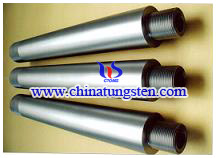
Tungsten Melting Electrodes
Tungsten Melting Electrodes of Chinatungsten
Tungsten melting electrodes for glass must withstand extremely high temperatures and aggressive glass melts. Tungsten melting electrodes from Chinatungsten are the right material for these challenging conditions.
-Melting point of 2 620 °C (4 748 °F)
-Outstanding creep resistance
-High dimensional stability
-Excellent corrosion resistance
-Good electrical and thermal conductivity
-Outstanding purity
When it comes to quality, we like to be in complete control. We produce our tungsten melting electrodes for glass ourselves, from the metal powder right through to the finished product. We use only the purest molybdenum oxide. In this way, we can be sure that our tungsten melting electrodes are free of any impurities, this prevents any discoloration or bubble formation. Owing to a special forging process, the tungsten melting electrodes we manufacture possess a particularly smooth surface. In addition, our forming processes result in a particularly coarse-grained, creep-resistant material structure coupled with optimum straightness.
Thus, tungsten melting electrodes are widely used. So if you have any interest in tungsten melting electrodes, please do not hesitate to contact us at sales@chinatungsten.com, sales@xiamentungsten.com. Price will be offered based on size, density, quantity, hardness, and any other specific requirements.





 sales@chinatungsten.com
 闽公网安备 35020602000140号